The big story today, of course, is the impeachment hearings going on in the U.S. House. They finally became public. However, I have maintained a distance from getting too wrapped up into these hearings, as I know good and well this is mostly done for political theater as there is a presidential election coming up next year, plus a slew of GOP-held seats in the House and the Senate up for grabs. There is no chance Trump will be removed, but this action by the Dems puts the GOP on the defensive.
Furthermore, I have been very sick over the past week to be much concerned about the circus in D.C. I am going to try and drag myself in to work tomorrow despite feeling bad. I am certain I had the flu; I had aches all over my body on top of the sinus pressure and coughing.
What I have been doing, among other things, is binge watching my DVDs of Naked City, the famous crime show of the late fifties and early sixties which aired on ABC for four seasons. The first season consisted of half-hour episodes starring James Franciscus and John McIntire (later of Wagon Train fame), with McIntire bumped off toward the end of the season because he was homesick for Montana and didn't want to remain stuck in New York, where the show was filmed. Horace McMahon took over as a precinct boss for the remainder of the series run.
This was a great show with many of the same people involved in the making of Route 66, one of the greatest television series ever made and the subject of a few posts on this blog over the years. With the likes of Herbert Leonard (who did the voice over for Naked City) and Stirling Silliphant (the creator) involved, there was little doubt as to the quality of the series.
However, ABC decided to pull the plug on the show after the first year. Then, for some reason, the network decided to bring the series back, only in an hour format, and with Paul Burke, the subject of some blog posts here. Like James Franciscus, he was an underrated actor but very good. Burke, as noted in my link to his obituary, did many of his own stunts on the show, which can take a toll on an actor's body over the years. He was justifiably proud of the work he did on the show. The gamble by the network to revive the series paid off, and Naked City ran for another three seasons.
I can vaguely remember the show during its initial run when I was a very little girl, but I hadn't seen it in over 55 years when I finally got the DVDs. Now I have been watching numerous episodes over the past several weeks.
The show was realistic and was filmed totally on location in NYC. Black and white suited it, for it made the city cold, harsh, and gritty. Which describes the show.
Like so many series of the time, it is fun to watch because you see all these actors who later became famous and were relatively unknown at the time, these actors even in very minor roles. The other day I watched an episode which featured Dick York as a doctor facing an ethical dilemma of treating an injured man who had committed a robbery. What was fun is the patient was none other than Bruce Dern, who had a very easy role being mostly flat on his back throughout the episode. Another crook in this apartment where York treated Dern, was played by Johnny Seven, a regular actor of many television series. Even more fun was a very, very young actor by the name of James Caan, another partner in crime who ended up as roadkill during this episode.
I know I have spoiled the episode for somebody by mentioning Caan's fate, but oh, well.
Another great in this episode was an appearance by Jean Syspleton.
Today I watched another episode, this one featured Sylvia Sidney as the "guest star." However, Robert Duvall played perhaps the more interesting character, of course, a criminal. Ed Asner had a small role on this episode playing a member of law enforcement. Uncredited parts in this episode included Godfrey Cambridge and Robert Blake.
Those actors who weren't hugely famous would always appear again and again on these television series. They were like members of a stock company, such as what Warner Brothers apparently had for their westerns, and they would be seen on show after show. These actors must have made a good living even if they didn't become major stars.
Anyway, this is what I have been doing while trying to recover from the flu. I am on season two of this show and finally got the third and fourth seasons. I might get the entire series done by the end of the year.
Showing posts with label classic television. Show all posts
Mr. Novak: Still Relevant After All These Years
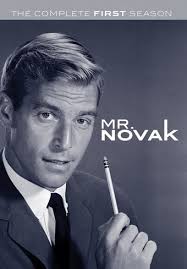
While I have taken a small break from watching my DVD of the first season of the 1960s drama Mr. Novak in favor of my annual binge watching of vintage Christmas films, I have been watching the series, one episode per day. After much fanfare and pressure, Warner Brothers issued the first season set of the series recently. It was worth the wait, I can say that.
Mr. Novak, starring actor James Franciscus as a sort of consolation prize after he bypassed Dr. Kildare in favor of shooting a pilot of a television series that never aired, was an NBC series lasting two seasons, 1963-1965. I remember the series as a child, but I never saw it during its first run. Like The Defenders, it was rarely if ever syndicated despite it being critically acclaimed. The series centered on a first-year high school English teacher, John Novak (excellently played by Franciscus), dealing with the various problems and issues facing the teaching profession. It was a series steeped in early sixties idealism commonplace with these great dramatic series and embodied by the Novak character. He also was tough and had high standards. It was one of the few television series centering on the teaching profession and in a realistic way.
It was probably too realistic, but one can credit the advisory panel of the NEA for that. The episodes rang true with me, decades after they were filmed, and the subjects still relevant today. It didn't matter what the subject. There were episodes dealing with racism, anti-semitism, inappropriate relationships between teachers and students, and one of them I recently watched dealt with the death of a teacher. Realistic as hell. Dean Jagger played the principal in the first season, and he was good. Jagger's character was not one of these dictatorial assholes I have come across in real life or incompetents who are supported by corrupt school districts like one I used to work for, and I am not naming any names. He always weighed the pros and cons before making a decision. The episodes did not always end on a happy note, either. Often it was left up to the viewer to draw conclusions over what happened to a character who didn't always get what he or she wanted.
There is also a book recently published about the series, which I plan to get.
At the time, Franciscus, who always reminded me of Richard Chamberlain at that time and I often got the two mixed up, was the son-in-law of director William Wellman. He had the connections, but he had real talent on top of his looks plus his Ivy League education (he was a Yale graduate). He went on to other series such as the one-season Longstreet, where he played a blind insurance investigator. It recently came out on DVD as well. Sadly, Franciscus, a four-pack-a-day smoker, died way, way too young, in 1991, at the age of 57 of emphysema. He left behind his second wife and four daughters from his marriage to Kitty Wellman. A fine talent who never got the recognition he deserved.
I highly recommend Mr. Novak to those interested in teaching and in classic television series. Here's hoping the second and final season comes out on DVD shortly.
The Lesbian and the Alleged Wife-Beater
I took a bit of a hiatus from buying DVDs--I don't stream or download many videos because I like having tangible media--but I capitulated when I recently got a DVD set of the 1972-1973 sitcom, Bridget Loves Bernie. I never saw it when it first aired beyond the opening credits which featured the stars--and later married and divorced couple--Meredith Baxter and David Birney gallivanting around NYC. The only reason I saw the opening credits was because the show aired between the CBS seventies powerhouses All in the Family (which I saw every first-run episode when it aired) and the Mary Tyler Moore Show, a show I watched much of during its original run, but I didn't watch it regularly like I did the other show (I have both series on DVD). Anyway, Bridget Loves Bernie had high ratings thanks to its schedule, but it was canceled after one season as a number of Jewish groups were not happy with the premise of a Catholic teacher (Baxter) marrying a Jewish cab driver and budding playwright (Birney). In real life, neither of the leads was Catholic or Jewish. Considering the 1970s were just a mere three decades after World War II and the Holocaust, it was little wonder why the groups were upset. They had concerns over the show sending the wrong message about interfaith marriage.
Sometimes, though, the opposition went overboard in its criticism of the series. Baxter remembered at one point there were bomb threats made. CBS ultimately capitulated to the pressure and canceled the show after one season.
In truth, the groups should have been more upset over the rather mediocre scripts. The series was clearly based on an old, old play called Abie's Irish Rose, and it had its share of silly stereotypes and mundane plots. Despite the attractiveness of the leads and the support of actors like Audra Lindley and Harold J. Stone (the latter seen on practically every television series during the first two decades of the medium), the scripts still stunk.
Yours truly is wading through the series. I have to admit the DVD quality is excellent, mastered from the original 35mm source elements, so it looks as good or better than when it was made. Even so, it is hard to get through it.
It is also hard to watch Baxter and Birney hanging all over each other--which was frankly overkill--knowing what ultimately happened. Baxter came from a showbiz family with her mother, Whitney Blake, looking like a beauty pageant contestant. Blake was best known for her work on the sixties sitcom, Hazel, and with her last husband helped create the seventies sitcom One Day at a Time. As for daughter Meredith, she was and would remain an attractive woman, but she wasn't the beauty her mother was. However, she did follow her mother into acting. Baxter already had a marriage, a divorce, and two kids under her belt by the time she met David Birney on the set of Bridget Loves Bernie (I remembered Birney from his work on the soap, Love is a Many Splendored Thing). A year or so after the series bit the dust, Baxter and Birney got married. They had three kids together. The marriage endured for fifteen years until they divorced in around 1989.
After the series bombed, Baxter went on to successes in television series such as Family Ties and Family. She won acclaim for portraying sociopathic murderer Betty Broderick, whom she resembled, in a TV movie. Birney led mostly a low-key existence being more involved in live theater and such.
I haven't read Baxter's memoirs, but from what I have read about them, she alleged Birney beat her up despite his being on the short side (I couldn't believe how short he was when I saw him on the series--he stood only 5 feet, 7 inches, the same height as Baxter). It was a hellish existence if her account is true, but Birney has long denied it. I think we can say the divorce wasn't amicable.
As we know, Baxter got to the point where she gave up on men altogether and discovered after decades she was more attracted to women. Three divorces and five children later, she married a contractor named Nancy Locke and presumably she is content now.
Because of the lame scripts and the real-life soap opera extending for decades after the series ended, it is hard to sit through Bridget Loves Bernie. Finally, the premise for the series was dated in 1972, and it is even more dated now.
As noted here, the hit series M*A*S*H* took over the time slot the next season. After Mary Tyler Moore, The Bob Newhart Show and The Carol Burnett Show completed the lineup, perhaps the strongest primeline lineup in television history. M*A*S*H* was replaced by the equally strong The Jeffersons. It was worth breaking dates on Saturday night to stay home.
Sometimes, though, the opposition went overboard in its criticism of the series. Baxter remembered at one point there were bomb threats made. CBS ultimately capitulated to the pressure and canceled the show after one season.
In truth, the groups should have been more upset over the rather mediocre scripts. The series was clearly based on an old, old play called Abie's Irish Rose, and it had its share of silly stereotypes and mundane plots. Despite the attractiveness of the leads and the support of actors like Audra Lindley and Harold J. Stone (the latter seen on practically every television series during the first two decades of the medium), the scripts still stunk.
Yours truly is wading through the series. I have to admit the DVD quality is excellent, mastered from the original 35mm source elements, so it looks as good or better than when it was made. Even so, it is hard to get through it.
It is also hard to watch Baxter and Birney hanging all over each other--which was frankly overkill--knowing what ultimately happened. Baxter came from a showbiz family with her mother, Whitney Blake, looking like a beauty pageant contestant. Blake was best known for her work on the sixties sitcom, Hazel, and with her last husband helped create the seventies sitcom One Day at a Time. As for daughter Meredith, she was and would remain an attractive woman, but she wasn't the beauty her mother was. However, she did follow her mother into acting. Baxter already had a marriage, a divorce, and two kids under her belt by the time she met David Birney on the set of Bridget Loves Bernie (I remembered Birney from his work on the soap, Love is a Many Splendored Thing). A year or so after the series bit the dust, Baxter and Birney got married. They had three kids together. The marriage endured for fifteen years until they divorced in around 1989.
After the series bombed, Baxter went on to successes in television series such as Family Ties and Family. She won acclaim for portraying sociopathic murderer Betty Broderick, whom she resembled, in a TV movie. Birney led mostly a low-key existence being more involved in live theater and such.
I haven't read Baxter's memoirs, but from what I have read about them, she alleged Birney beat her up despite his being on the short side (I couldn't believe how short he was when I saw him on the series--he stood only 5 feet, 7 inches, the same height as Baxter). It was a hellish existence if her account is true, but Birney has long denied it. I think we can say the divorce wasn't amicable.
As we know, Baxter got to the point where she gave up on men altogether and discovered after decades she was more attracted to women. Three divorces and five children later, she married a contractor named Nancy Locke and presumably she is content now.
Because of the lame scripts and the real-life soap opera extending for decades after the series ended, it is hard to sit through Bridget Loves Bernie. Finally, the premise for the series was dated in 1972, and it is even more dated now.
As noted here, the hit series M*A*S*H* took over the time slot the next season. After Mary Tyler Moore, The Bob Newhart Show and The Carol Burnett Show completed the lineup, perhaps the strongest primeline lineup in television history. M*A*S*H* was replaced by the equally strong The Jeffersons. It was worth breaking dates on Saturday night to stay home.
For Dog Lovers
I love this episode of Alfred Hitchcock Presents called "The Kerry Blue":
The show always had twists and surprise endings, but this one just about takes the cake.
One of the Legendary Episodes
of the classic Alfred Hitchcock Presents series and directed by Hitch himself:
Scary and realistic as all get-go.
Sci-Fi Pygmalion
Although I am broke as anything, I did order a couple of DVDs through Amazon (I don't do much in the way of downloads of TV series when I prefer to have the prerecorded shows for collection purposes and I don't subscribe to Netflix which is a waste of money). One of them I got was what remains of the old sixties sitcom My Living Doll starring Bob Cummings and Julie Newmar. It ran on CBS during the 1964-1965 season. I had already seen a handful of episodes on YouTube, but I wanted to get a collection of what remained of the show. Sadly, all of the 35mm copies of the series were destroyed in the 1994 Northridge earthquake, so the people who put together the DVD had to round up episodes from various collectors. The video quality of the 11 (so far) surviving episodes is good, and, contrary to the Andrews and Dunning book, The Worst TV Shows Ever from around 30 years ago, it doesn't rank anywhere near the worst. The show in fact has quite a bit of charm to it, and Julie Newmar did very well in a role that was extremely difficult to play (that of the robot Rhoda Miller), according to her and others who worked on the series. It helped she had been a dancer and had also studied mime. While the show's producers thought Bob Cummings had been miscast in the role of the Air Force psychiatrist who was in charge of the robot as he was in his fifties while Newmar was 29 when the show began, he was actually very good in the part. I would have a hard time with anybody else in the role, which was very similar to the part he played in the long-running series The Bob Cummings Show.
Furthermore, the part called for an older actor, as the show was obviously modeled on the "Pygmalion" theme but with a sci-fi twist. It is more obvious when one of the most popular films in the country during 1964 was the Oscar-winning film, My Fair Lady. A younger actor would have made the relationship with the robot downright creepy, if not perverted. Cummings was perfect for the part.
Unfortunately, there were problems with the show from the start. Mostly, the Sunday night schedule guaranteed it would not last because it was opposite the hit NBC series Bonanza. Even after it was moved to a different day and time slot, the ratings never rose from the cellar. It was also guaranteed to be cancelled because the person who approved the series, CBS president James T. Aubrey, was kicked out of the network thanks to scandal. The network did a housecleaning not just of this series but also of many other series including those produced by Aubrey gofer Keefe Brasselle*, who I think I mentioned on this blog some years ago. Brasselle was one of those guys with a lot of ambition, but he had utterly no talent for anything except failure.
Furthermore, Cummings, despite all of his considerable comic talent, tended to be a bit of a control freak and actually had the nerve to try and direct Newmar on occasion, forgetting that the series was supposed to be about HER and not him. Contrary to rumor, however, there wasn't a feud between the two, at least that is what I understand having seen one of the "extras" on the DVD release about the making of the show. Newmar said everything was professional on the set. She and others who had worked on the show did not know why Cummings decided to up and leave when there were still five episodes left to film. This article from the Los Angeles Times gives one a clue as to what happened with Cummings:
It seems that while The Bob Cummings Show left the air, the show hadn't left Bob Cummings, much to the exasperation of those working on My Living Doll. On the former series, he DID control it and had directed quite a few of the episodes. When he finally realized My Living Doll wasn't HIS Living Doll, he just said to hell with it and walked away. The show limped along five more weeks and then not renewed for a second season.
It's still worth watching the series even if it is silly. It was typical of the "gimmick" shows that flourished on network television at the time, but certainly no worse than any of them and not worthy at all of inclusion in a "worst television show in history" list.
*--About Keefe Brasselle, I wrote about him here.
Furthermore, the part called for an older actor, as the show was obviously modeled on the "Pygmalion" theme but with a sci-fi twist. It is more obvious when one of the most popular films in the country during 1964 was the Oscar-winning film, My Fair Lady. A younger actor would have made the relationship with the robot downright creepy, if not perverted. Cummings was perfect for the part.
Unfortunately, there were problems with the show from the start. Mostly, the Sunday night schedule guaranteed it would not last because it was opposite the hit NBC series Bonanza. Even after it was moved to a different day and time slot, the ratings never rose from the cellar. It was also guaranteed to be cancelled because the person who approved the series, CBS president James T. Aubrey, was kicked out of the network thanks to scandal. The network did a housecleaning not just of this series but also of many other series including those produced by Aubrey gofer Keefe Brasselle*, who I think I mentioned on this blog some years ago. Brasselle was one of those guys with a lot of ambition, but he had utterly no talent for anything except failure.
Furthermore, Cummings, despite all of his considerable comic talent, tended to be a bit of a control freak and actually had the nerve to try and direct Newmar on occasion, forgetting that the series was supposed to be about HER and not him. Contrary to rumor, however, there wasn't a feud between the two, at least that is what I understand having seen one of the "extras" on the DVD release about the making of the show. Newmar said everything was professional on the set. She and others who had worked on the show did not know why Cummings decided to up and leave when there were still five episodes left to film. This article from the Los Angeles Times gives one a clue as to what happened with Cummings:
Cummings left the show with five episodes to go because they wouldn't film one he had written in which he played his own grandfather. "It was centered around his character," said Greenwood. "It was really Julie's show -- you can't take away the focus from her."
It seems that while The Bob Cummings Show left the air, the show hadn't left Bob Cummings, much to the exasperation of those working on My Living Doll. On the former series, he DID control it and had directed quite a few of the episodes. When he finally realized My Living Doll wasn't HIS Living Doll, he just said to hell with it and walked away. The show limped along five more weeks and then not renewed for a second season.
It's still worth watching the series even if it is silly. It was typical of the "gimmick" shows that flourished on network television at the time, but certainly no worse than any of them and not worthy at all of inclusion in a "worst television show in history" list.
*--About Keefe Brasselle, I wrote about him here.
Blast From the Past
Not one of my favorite shows growing up and still not one of my favorites, but I thought I'd share this YouTube featuring a pair who reached much greater fame on the big screen:
This was the second episode of the series. Of course Beatty and Weld didn't stick around on this show for very long.
I have been watching a few of these episodes, most of which I haven't seen in decades. It wasn't the worst show ever made, but I can tolerate it more now than years ago.
This was the second episode of the series. Of course Beatty and Weld didn't stick around on this show for very long.
I have been watching a few of these episodes, most of which I haven't seen in decades. It wasn't the worst show ever made, but I can tolerate it more now than years ago.
Classic Lucille Ball
Two famous scenes from I Love Lucy. This show never ceases to make me roll on the floor:
From "Lucy Does the Tango":
From "Lucy's Italian Movie":
Simply timeless.
From "Lucy Does the Tango":
From "Lucy's Italian Movie":
Simply timeless.
News, Etc,
Naturally no teachers were invited to an "education" summit rigged with know-nothings from the business world.
Of course Obama doesn't know anything about public education.
_____
Turner Classic Movies (the best cable channel bar none) is having an all-day birthday tribute to Red Skelton (1913-1997), one of my all-time favorites. I used to watch his television show religiously in the 1960s. The best thing about him was he refused to stick to the script. In this classic live clip from the 1950s, Red wasn't the only one who refused to stick to a script:
They don't make comedians like this anymore. Now it's all shock value and obscenities.
_____
Of course Obama doesn't know anything about public education.
_____
Turner Classic Movies (the best cable channel bar none) is having an all-day birthday tribute to Red Skelton (1913-1997), one of my all-time favorites. I used to watch his television show religiously in the 1960s. The best thing about him was he refused to stick to the script. In this classic live clip from the 1950s, Red wasn't the only one who refused to stick to a script:
They don't make comedians like this anymore. Now it's all shock value and obscenities.
_____
I Have Been Enjoying Watching Season Two
of The Donna Reed Show, which lasted for eight years (1958-1966). It was one of those wholesome family shows of the Ike era, but it was widely criticized for being "unrealistic." Well, that wasn't really true for millions of families of that time. Many were close to this "ideal." What separated this program from the others was the fact the mother, in this case Donna Reed, was the center of the show, obviously, or else her name wouldn't be in the title. The other shows it would be the father or the kids or both at the center, with the mothers being on the sidelines for the most part. But in this show, Reed is at the center of the plots.
She had great chemistry with her onscreen husband Carl Betz, who played a doctor with not only an office in the family residence, but he actually made house calls. I think the two "child" actors, Paul Petersen and Shelley Fabares, also had great chemistry with each other and with the adults. Of course Fabares is now married to actor Mike Farrell and has been for years but has mostly dropped out of sight since her health problems early this decade. As for Petersen, he was once married to actress Brenda Benet, who in turn married and divorced actor Bill Bixby and later committed suicide not long after the death of Benet and Bixby's young son. She was said to have been involved with a teenaged Tammy Bruce at the time of her death, and Bruce discovered her body.
Anyway, Petersen went on to marry two more times and has an organization to help child actors. He also made frequent appearances at the Hot August Nights celebration in Reno, though I don't think he was there this year. For some reason I never got his autograph when I went to the Peppermill during his many appearances at HAN.
Reed and Betz died too young, both of cancer. Reed is featured in a chapter of a book on pioneer female TV comedy stars, The Women Who Made Television Funny. I recommend this book.
She had great chemistry with her onscreen husband Carl Betz, who played a doctor with not only an office in the family residence, but he actually made house calls. I think the two "child" actors, Paul Petersen and Shelley Fabares, also had great chemistry with each other and with the adults. Of course Fabares is now married to actor Mike Farrell and has been for years but has mostly dropped out of sight since her health problems early this decade. As for Petersen, he was once married to actress Brenda Benet, who in turn married and divorced actor Bill Bixby and later committed suicide not long after the death of Benet and Bixby's young son. She was said to have been involved with a teenaged Tammy Bruce at the time of her death, and Bruce discovered her body.
Anyway, Petersen went on to marry two more times and has an organization to help child actors. He also made frequent appearances at the Hot August Nights celebration in Reno, though I don't think he was there this year. For some reason I never got his autograph when I went to the Peppermill during his many appearances at HAN.
Reed and Betz died too young, both of cancer. Reed is featured in a chapter of a book on pioneer female TV comedy stars, The Women Who Made Television Funny. I recommend this book.
Miscellaneous News
I am thrilled to read the Nature Conservancy purchased some 1,700 acres of land on the Table Rocks to preserve it for future generations. The BLM also owns some of the land.
Here is what is special about these southern Oregon landmarks:
_____
If you are like me and are into classic television and even classic television ads, you may be interested in looking at this site with a plethora of classic cigarette commercials.
In my view, the best television ads ever made were the cigarette ads. Despite the fact tobacco is a filthy, dangerous product, and the tobacco companies knew about the dangers for decades, the ads were about the best. I really mourned the day they were taken off of television back in 1971.
The Benson & Hedges 100s ads from 1966-67 are truly legendary and may be the best of them all. I loved those ads when they first aired all those years ago, and it is great to be able to see them again.
The Virginia Slims ads were almost as great, and they, too, employed humor.
One can also download the videos for his or her own use.
I do notice, though, the classic Tareyton "I'd rather fight than switch" ads aren't there. Those were the ones showing people with black eyes.
Edit: A couple of Tareyton ads, as well as others, can be found at this site. You can also find the William Talman and Yul Brynner anti-smoking commercials there.
_____
Here is what is special about these southern Oregon landmarks:
Atop the Table Rocks, vernal pools pop up following a spring rain, spawning fairy shrimp that are federally protected as a threatened species. Springing from the earth are the rare dwarf woolly meadowfoam, found nowhere on the planet except the Table Rocks.
"Our goal was to protect it for perpetuity — this completes that goal," he says.
The Nature Conservancy's nearly $4 million purchase of some 1,710 acres of land on the Table Rocks from the Wood Family Trust culminates its 30-year commitment to protect all of the Table Rocks. The U.S. Bureau of Land Management, which owns the remainder of both rocks, already has placed land on and around the rocks under protection as areas of critical environmental concern.
The conservancy will be working closely with the BLM, Jackson County, state agencies and the U.S. Fish and Wildlife Service to determine how to best protect both wildlife habitat and recreational activities, Borgias says.
...
The rock islands are believed to be the last remains of a river of lava that flowed some 7 million years ago from a volcano immediately east of what is now Lost Creek Lake. Geologists say the rest of the lava eroded away, leaving the horseshoe-shaped plateaus towering over the valley floor.
Come spring, the Table Rocks with their thin soils offer a wildflower show, from the white-colored meadowfoam to the light blue camas.
The Nature Conservancy's acquisition includes a portion of the southwest slope of Upper Table Rock, where a field of camas plants is now in full bloom.
_____
If you are like me and are into classic television and even classic television ads, you may be interested in looking at this site with a plethora of classic cigarette commercials.
In my view, the best television ads ever made were the cigarette ads. Despite the fact tobacco is a filthy, dangerous product, and the tobacco companies knew about the dangers for decades, the ads were about the best. I really mourned the day they were taken off of television back in 1971.
The Benson & Hedges 100s ads from 1966-67 are truly legendary and may be the best of them all. I loved those ads when they first aired all those years ago, and it is great to be able to see them again.
The Virginia Slims ads were almost as great, and they, too, employed humor.
One can also download the videos for his or her own use.
I do notice, though, the classic Tareyton "I'd rather fight than switch" ads aren't there. Those were the ones showing people with black eyes.
Edit: A couple of Tareyton ads, as well as others, can be found at this site. You can also find the William Talman and Yul Brynner anti-smoking commercials there.
_____
December Bride
I am watching the second volume of the 1954-1959 television series put out by Desilu, December Bride, starring Spring Byington (1886-1971). I remember this series when it was in syndication in the early 1960s, but I hadn't seen it since that time. Byington, who was close to 70 when the show began, had a sweet if comic presence on the show in her role as a live-in mother-in-law to her daughter, played by Frances Rafferty (1922-2004), and son-in-law Dean Miller (1924-2004). Byington was aided in her adventures by Verna Felton (1890-1966), who played Ethel Mertz to Byington's Lucy. The resemblances to the legendary I Love Lucy are obvious. Desilu produced both, the show had a similar theme song to Lucy and was conducted by William Hatch, it followed I Love Lucy on the CBS schedule, and like Lucy it was performed in front of a live audience.
The best thing about the show was henpecked Pete Porter, played by none other than Harry Morgan (born 1915), best remembered for his role as Colonel Potter in the M*A*S*H television series after McLean Stevenson departed. Morgan bellyached constantly about his wife, Gladys, who was never seen on camera but was actually a main character on the show in her absence. Morgan had some of the best lines and was memorable in the part. Eventually he had his own show, one of the earliest television spinoffs, Pete and Gladys, with the role of Gladys played by Cara Williams. It last just two seasons. I was a little child when this show ran, but I remember it.
Spring Byington is mostly forgotten today, which is a shame. She was talented and an interesting individual who was a pilot in real life, among her many hobbies. Unfortunately, some "biographers" think her rumored lesbian relationship with character actress Marjorie Main was more important than what she did in her career. Byington wasn't any pioneer for gay rights; however, she was a pioneer for women in television.
Anyway the show was cute if not a classic. It is one of those vintage shows which should have a legitimate release, but I purchased the unauthorized DVDs just to get a chance to see it again.
A few episodes of December Bride can be seen on YouTube.
The best thing about the show was henpecked Pete Porter, played by none other than Harry Morgan (born 1915), best remembered for his role as Colonel Potter in the M*A*S*H television series after McLean Stevenson departed. Morgan bellyached constantly about his wife, Gladys, who was never seen on camera but was actually a main character on the show in her absence. Morgan had some of the best lines and was memorable in the part. Eventually he had his own show, one of the earliest television spinoffs, Pete and Gladys, with the role of Gladys played by Cara Williams. It last just two seasons. I was a little child when this show ran, but I remember it.
Spring Byington is mostly forgotten today, which is a shame. She was talented and an interesting individual who was a pilot in real life, among her many hobbies. Unfortunately, some "biographers" think her rumored lesbian relationship with character actress Marjorie Main was more important than what she did in her career. Byington wasn't any pioneer for gay rights; however, she was a pioneer for women in television.
Anyway the show was cute if not a classic. It is one of those vintage shows which should have a legitimate release, but I purchased the unauthorized DVDs just to get a chance to see it again.
A few episodes of December Bride can be seen on YouTube.
Classic Television
In order to take my mind off of the sinking economy, I have been trying to focus on other interests, one reason I haven't blogged a huge amount in recent weeks. One of the things I have been doing is getting DVDs of old television series from the 1950s and 1960s. I recently received a DVD of public domain episodes of the early 1950s sitcom Beulah, the first television sitcom featuring an African American actress in the main role. Originally it starred Hattie McDaniel of Gone With the Wind fame, but when ill health forced her to quit (she died of breast cancer in 1952), Louise Beavers took over the part. Ethel Waters and Amanda Randolph (Sapphire's mother in Amos 'n' Andy) also played the part during the series' run.
Like Amos 'n' Andy, the show came under fire from the NAACP and the like for supposedly treating blacks in a stereotyped manner. In reality, the show was pretty harmless, and it has been compared with the 1960s sitcom Hazel, which was about a housekeeper/maid who had more wisdom than the rest of the cast. Seen in that light, Beulah was not at all insulting, for the "Beulah" character was almost identical to the "Hazel" character.
Rumor has it there are only a handful of episodes in existence, but since the show was filmed rather than performed live, I would think there would be more episodes than the seven rumored to exist.
Like Amos 'n' Andy, the show came under fire from the NAACP and the like for supposedly treating blacks in a stereotyped manner. In reality, the show was pretty harmless, and it has been compared with the 1960s sitcom Hazel, which was about a housekeeper/maid who had more wisdom than the rest of the cast. Seen in that light, Beulah was not at all insulting, for the "Beulah" character was almost identical to the "Hazel" character.
Rumor has it there are only a handful of episodes in existence, but since the show was filmed rather than performed live, I would think there would be more episodes than the seven rumored to exist.
A Couple of Legendary TV Flops to Note
In this clip, one of three on YouTube, Jackie Gleason had tried in vain to save his disaster of a game show, You're in the Picture (1961), by issuing an on-air apology:
He made the show into a talk show format.
More about this turkey is here.
And over at Classic Television Showbiz, there are three clips from a complete episode of the legendary 1966 disaster, The Tammy Grimes Show, which was canceled by ABC after only four episodes. This episode also has the original commercials.
Both I have saved to my iPod.
He made the show into a talk show format.
More about this turkey is here.
And over at Classic Television Showbiz, there are three clips from a complete episode of the legendary 1966 disaster, The Tammy Grimes Show, which was canceled by ABC after only four episodes. This episode also has the original commercials.
Both I have saved to my iPod.
Since There
isn't anything worth a damn to link or write about, I thought I'd put this link of a video of the first episode of the Joan Davis television comedy, I Married Joan, with Jim Backus as her husband, Judge Brad Stevens.
The show wasn't that bad, sometimes it was quite funny, although it didn't have the consistently good writing I Love Lucy had:
LikeTelevision Embed Movies and TV Shows
Another episode, "Bad Boy," can be found here.
The show wasn't that bad, sometimes it was quite funny, although it didn't have the consistently good writing I Love Lucy had:
LikeTelevision Embed Movies and TV Shows
Another episode, "Bad Boy," can be found here.
When You're Cooped Up
in the apartment all day because of rain and snow, there isn't a whole lot to do besides watch DVDs (I refuse to look at the pundits and their corrupt analysis of Campaign 2008). I popped in one of my discs of season three of The Wild Wild West, one of my favorite shows from the 1960s.
I remember the series like it was yesterday, so I have gotten all of the volumes so far. I think what made the show work is the fact stars Robert Conrad and Ross Martin got along so well. Apparently they became best friends in real life, and, when Martin died suddenly in 1981, Conrad refused to do any more projects in connection with the series.
Conrad, as everybody knows, has been pretty much out of the limelight after being involved in a serious DUI car accident in 2003, I think it was. He was the one who was intoxicated, but he ended up getting the worst of it injury-wise. For years, he and his second wife lived up in Bear Valley, California, but last I've heard they've since moved back to southern California.
In his prime in the 1960s, though, he was quite the eye candy, despite having a wife (wife number one) and several kids to support. I am well aware of his right-leaning politics, which go back many, many years, but some things in life transcend partisan politics. I don't need that dumb shit Obama to remind me of it, either.
I can't write about WWW and not mention "the pants." I thought this Conrad interview of a couple of years ago was good:
Edit, January 5: At least one of the episodes, "The Night of the Underground Terror," telecast in the third season, Conrad split his pants big time some 46 minutes into the episode. I laughed my ass off when I saw it. I am surprised another take wasn't done.
They should have titled the episode, "The Day of the Underwear Tear."
I remember the series like it was yesterday, so I have gotten all of the volumes so far. I think what made the show work is the fact stars Robert Conrad and Ross Martin got along so well. Apparently they became best friends in real life, and, when Martin died suddenly in 1981, Conrad refused to do any more projects in connection with the series.
Conrad, as everybody knows, has been pretty much out of the limelight after being involved in a serious DUI car accident in 2003, I think it was. He was the one who was intoxicated, but he ended up getting the worst of it injury-wise. For years, he and his second wife lived up in Bear Valley, California, but last I've heard they've since moved back to southern California.
In his prime in the 1960s, though, he was quite the eye candy, despite having a wife (wife number one) and several kids to support. I am well aware of his right-leaning politics, which go back many, many years, but some things in life transcend partisan politics. I don't need that dumb shit Obama to remind me of it, either.
I can't write about WWW and not mention "the pants." I thought this Conrad interview of a couple of years ago was good:
And then there were those, um, tight pants.
"Some of the apparatus I wore wasn't visible, like the equipment I wore under those pants to protect myself from a fall," Conrad says with a chuckle. "There was stuff under my costumes to protect me from hurting my spine. So that's why they were so tight. But it was wardrobe's call.
"My granddaughter was watching the DVDs with me last night and she elbows me and says, 'Grandpa, those pants were too tight.' Everybody's a critic."
Edit, January 5: At least one of the episodes, "The Night of the Underground Terror," telecast in the third season, Conrad split his pants big time some 46 minutes into the episode. I laughed my ass off when I saw it. I am surprised another take wasn't done.
They should have titled the episode, "The Day of the Underwear Tear."
I Was Surfing Around
the internet, and I came across this blog about classic television that I thought I'd link here (I have it linked on the links blog, too).
There are lots of video clips on that site.
I Am
sitting around here watching bootleg DVDs of the classic Amos 'n' Andy program, which lasted from 1951 to 1953 and pulled from syndication by CBS in 1966, thanks to boneheaded protests from the NAACP.
It was a great comedy, right up there with the best of the 1950s, and it never should have been consigned to the vaults.
Oh, people like Bill Cosby rant and rave about the show's alleged racism, but frankly the show would have been just as funny had the characters been white rather than black.
It's been often compared with The Honeymooners, and I believe the comparison is apt. It seems that show borrowed a great deal from Amos 'n' Andy.
The problem was there were no other shows at the time depicting African Americans in different roles, and therefore this comedy was singled out.
What a shame.
I've written about this show before. I had bootleg VHS tapes of it, but only about half of the shows. This version has 71 of the 78 episodes. I don't know if the remainder were lost.
It was a great comedy, right up there with the best of the 1950s, and it never should have been consigned to the vaults.
Oh, people like Bill Cosby rant and rave about the show's alleged racism, but frankly the show would have been just as funny had the characters been white rather than black.
It's been often compared with The Honeymooners, and I believe the comparison is apt. It seems that show borrowed a great deal from Amos 'n' Andy.
The problem was there were no other shows at the time depicting African Americans in different roles, and therefore this comedy was singled out.
What a shame.
I've written about this show before. I had bootleg VHS tapes of it, but only about half of the shows. This version has 71 of the 78 episodes. I don't know if the remainder were lost.
The Ultimate Reality TV Show
When I think of the thousands of television shows that have appeared over the past 55 plus years of television history, there are only a few shows standing out as the all-time worst. Gilligan's Island was a piece of brainless matter in which everything possible on the island was found except a funny script (stole that line from Andrews and Dunning's great Worst TV Shows Ever, published in 1980); Happy Days was a huge hit in the mid-1970s but is virtually unwatchable because in addition to the stupid dialogue, the clothing and hairstyles never seemed to fit with the era being depicted; Three's Company was unbearable in its double and triple entendres; legendary shows like Turn-On and You're In the Picture were fiascos as they were canceled after a single broadcast; and anything produced by Chuck Barris was a paean to bad taste. These are only a few of the worst that come to mind right now.
However, there is one show that stands above all in the bad taste department, one show that took reality television to almost the extreme, one show that is the standard by which all other terrible television is measured: Queen for a Day, which ran on radio from 1945 to 1956 and on national television from 1955 to its tragic cancellation in 1964.
Many words have been written about this show, but since it was broadcast live from the Moulin Rouge restaurant in Hollywood, few episodes exist today (I have two episodes that are available through Shokus Video). This is very unfortunate because if more episodes existed, I have no doubt in my mind it would be a cult television series.
For those of you too young to remember the show, it went something like this:
Five (later four) women chosen from the audience competed for money and prizes by telling the immortal host Jack Bailey (one-time carnival barker, one-time voice of Walt Disney's Goofy) what item they wanted and why they wanted it. Most of the items were mundane; for example, a babysitter for several children, a job for a spouse, a wheelchair for a disabled child, but what sold viewers on the show was women telling miserable stories of why they wanted the item. The more miserable the story, the more likely the audience would sympathize. After Bailey's interviews, which were often humiliating, Bailey then had the camera pointed on each woman, and the audience would applaud. The applause was measured by an "applause meter." The woman who generated the loudest applause would be crowned "Queen for a Day." Bailey, in his element, would yell the immortal cry, "And I crown you QUEEN for a DAY!"
To the tune of "Pomp and Circumstance," the lucky woman then was wrapped in a tacky robe, crowned with a tacky tiara, and escorted to a tacky throne. The scantily-clad models would then present her with a dozen roses (thorns removed) and then the "fun" begins. The woman would invariably be granted whatever item she wanted (only items that could be plugged were allowed; no medical or legal help was allowed because of the inability to determine the expense of such help). Each day some $3,500 worth of appliances and other items (a lot of items back then in the late fifties and early sixties) would be presented, and Bailey and the announcer would talk about all of the virtues of each. Watching the surviving episodes, what one sees is a nifty piece of mid-century popular culture and consumerism, to say nothing of the brashness of the bad taste. After the plugs (which took up most of the show), Bailey would sign off.
Critics unanimously blasted the show. One critic, referring to the president of NBC, despaired, "What hath Sarnoff wrought?" Another called it a "chamber of horrors." It didn't matter; the show was a hit and remained so throughout most of its run. Eventually ratings dropped, and, when I was in fourth grade in the fall of 1964, it was canceled and replaced by a fictional soap opera. Apparently the real thing wasn't good enough for viewers.
One virtue the game show had over so many at the time was it wasn't rigged. "Queen for a Day is an honest show. If you can prove otherwise, then hop to it. Every promise we make is fulfilled. Every gift we say will be delivered, is delivered. That's more than can be said for a number of other giveaway shows. As for me, I genuinely enjoy meeting and talking to all these people. If I didn't enjoy it, I'd have left the show years ago. Our contestants aren't phony, and our emcee can't afford to be, either. The camera and the studio audience would spot it in a minute,'" said host Jack Bailey (1910-1979) to TV Guide in the June 22-28, 1957 issue.
When asked about whether the show was exploiting people for ratings, whether it was yet another "kick the cripple" spectacle like another legendary game show, Strike It Rich, Bailey said this:
"Well, that's really not a fair question. To begin with, the weeping on the show isn't half so evident as people seem to think. Sure, most of the queens break down and cry when they're crowned, but those are pretty happy tears. As for the sob stuff, I just don't let it happen if I can possibly help it. A woman who looks as though she'll really break down doesn't get picked as one of the five daily contestants. And if one of them starts the tears on the air, I can generally manage to kid her out of it in a nice way.
"We don't deal in tears for the sake of tears. We try to keep this a happy show. People come to us in trouble. If we can cheer 'em up and help 'em out with a lot of gifts they've never dreamed of owning, then we figure we have brought a little happiness into the world where it didn't exist before. If this can be called 'preying on human emotions,' then I guess we're guilty. The audience must like it; otherwise we wouldn't be one of the top-rated daytime shows on the air."
Not only was Queen top-rated, it also gave away more prizes than any other game show. By 1957, the program had given away nearly $14,000,000. A windfall of wonderfulness, if only for little while. After the euphoria of winning all of those gifts and going to a night on the town, the lucky winner went back to the same old problems.
There was an attempt to revive the series in the early 1970s, but without Jack Bailey hosting the proceedings, it flopped. Though Bailey is no longer with us in body, his huckster spirit is alive and well with the likes of Oprah Winfrey, Survivor, Big Brother, and of course our most beloved short-term game show host, Monica Lewinsky.
Bailey and Queen were big parts of my childhood, and I will always remember both fondly.
Source for this post: Bart Andrews and Brad Dunning's excellent The Worst TV Shows EVER, 1980.
Subscribe to:
Comments (Atom)
Featured Post
The View from Grizzly Peak
Today I went on a group hike through the Medford Parks and Recreation Department to Grizzly Peak, which is located in the Cascade-Siskiyou M...
-
On a somewhat off track, Sovereignty has won the 151st Kentucky Derby for Godolphin Stable. Journalism, the favorite, came in second, whi...
-
Journalism has won the 150th Preakness Stakes. It was an extremely tight far turn into homestretch. I am happy nobody was hurt, but I thin...
-
Early today marked the passing of 1950s French icon Brigitte Bardot, who was 91 years old and had mostly been out of the limelight since ret...